Define & steer
References, priorities, model choices and acceptance criteria.
HUMAN-DIRECTED AI / PROJECT 01 / 2026
A multi-model agent workflow, directed by me and tested in the simulator.
Demetris Dangerfield / NeuroAI Studios. Orchestrating Codex, Claude, specialist agents and distributed hardware to turn aircraft references into an evolving simulation.
Independent development project. Latest documented installation: 0.5.74. Visual and runtime acceptance remains open.
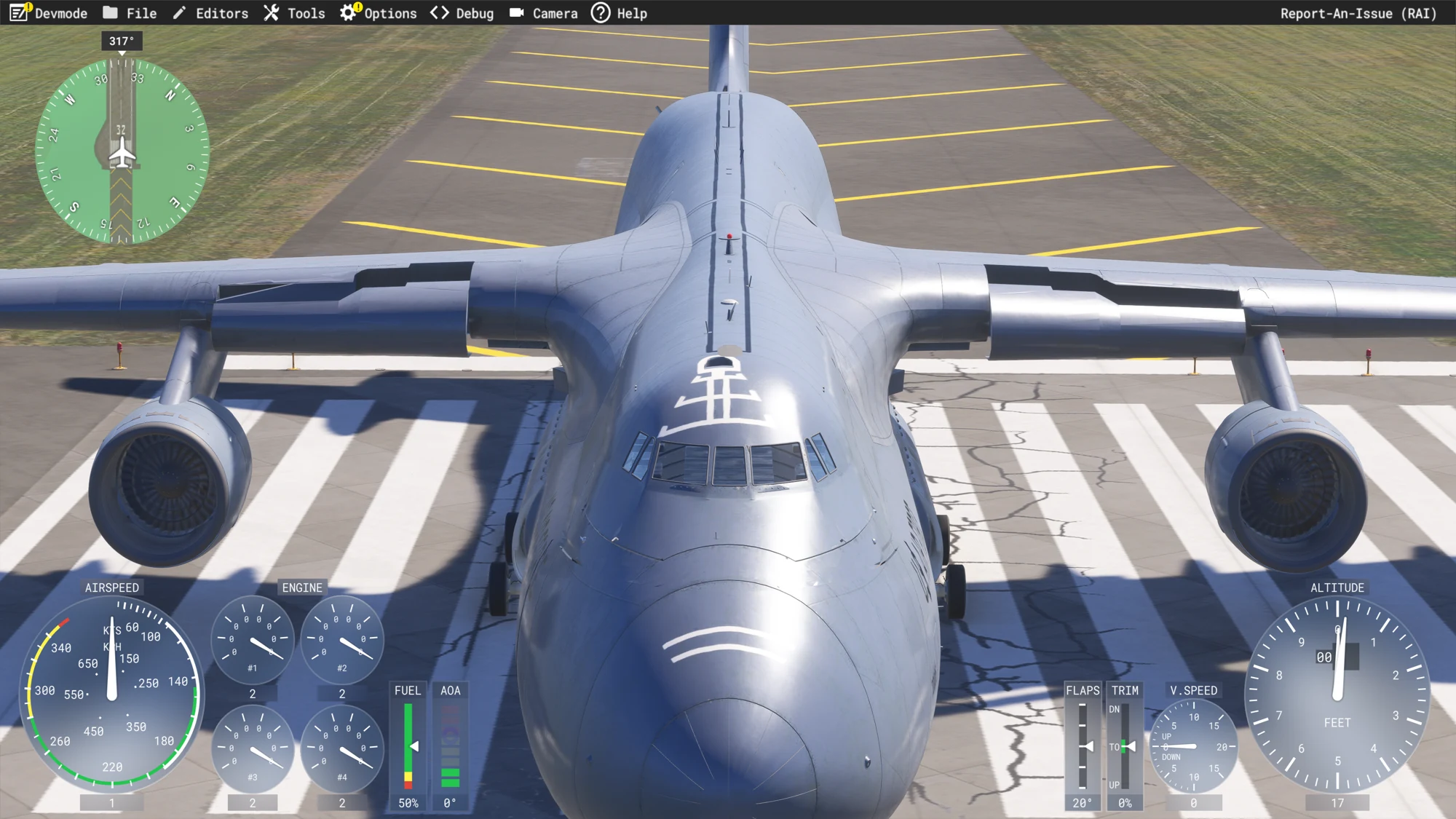
HUMAN DIRECTION / FRONTIER MODELS / DISTRIBUTED TOOLS
Demetris Dangerfield directed Codex and Claude through reference research, specialist production, independent review, and simulator feedback. Model assignments and hardware supported a process whose acceptance criteria stayed with the human owner.
MY ROLE AS OWNER AND DIRECTOR
I set the target, supplied references and compute, chose model assignments, limited concurrency, and reviewed the aircraft in MSFS. My screenshots and corrections became the next round of scoped work. Coordinator agents translated that direction into technical briefs and controlled integration.
References, priorities, model choices and acceptance criteria.
Read-only baseline, lane ownership, constraints and deliverables.
Private candidates, deterministic apply scripts and actual images.
Broken-input controls, exact hashes and complete-context views.
Controlled install, native simulator checks and human feedback.
Owner observation feeds the next brief. A green local result does not overrule what the owner sees in the simulator.
RECORDED MODEL MIX
Names below come from selected local session metadata and task records. They describe this project history.
Recorded identifiers: claude-opus-5 and claude-opus-5-5. Opus task briefs document visual and interaction specialists, including fire-panel finish and Taxi Cam defaults.
Recorded identifier: gpt-6-sol. The later owner rules select SOL, cap the team at ten agents across tools, and require an independent judge for each changed round.
Recorded identifier: gpt-6-astra. A September 27 repair assigned four agents to nose, rudder, export and independent review. The owner later switched the workers to SOL.
Recorded identifier: claude-fable-5. It appears in earlier selected Claude sessions. This review does not assign it a distinct asset contribution without a task receipt.
The model inventory is bounded, and records are not a performance benchmark. The ten-agent limit is a policy, not a claim of continuous ten-agent execution.
THE COMPUTE BEHIND THE WORKFLOW
Core i5-14400F
RTX 5080 / 16 GB class
32 GB class system memory
Blender 4.5, Substance 3D Painter, Python and PowerShell, the MSFS SDK, and the actual simulator. Hardware read back October 1, 2026.
2 × NVIDIA GB10
121 GB reported per host
Queued Blender rendering
Packed scenes, transfer hashes, memory guards and separate heavy, light and CPU queues. One interior GPU render at a time on each host.
Exclusive Painter lock
One owner per lane
Continue from evidence
Check live jobs before resuming. Do not kill another lane's work. Rerun missing or stale outputs, then hash-verify the result before integration.
Frontier-model sessions directed the tools. The documented Spark role was rendering and asset analysis; these records do not establish local hosting of the named frontier models.
A REAL ORCHESTRATION EXAMPLE / SEPTEMBER 21
Emergency-panel paint was wrong. Overhead placement and motion looked wrong. Pilot lighting was missing. Taxi Cam screens were absent. The EFB was dark and unresponsive.
Five specialist briefs, private lane folders, unique asset prefixes, a named baseline and a defined composition order. Each specialist delivered candidates and apply scripts for controlled integration.
Same-camera day and night images, protected animation and click bindings, failing precondition controls, exact candidate hashes, and the native checks still required.
THE BRIEF
The goal was a convincing C-5M experience from the pilot's seat to the cargo-loading doors.
The work grew into a coordinated program of reference capture, cockpit reconstruction, surface finishing, display and control integration, exterior diagnosis, distributed rendering, and safe installation. Each stage had to answer a different question: does the part match the reference, does it survive export, and does it actually work in the simulator?
Demetris set the visual direction, selected references and hardware resources, directed the AI work, reviewed simulator behavior, and used owner screenshots to drive corrections. This case study presents the achieved work together with its documented limits.
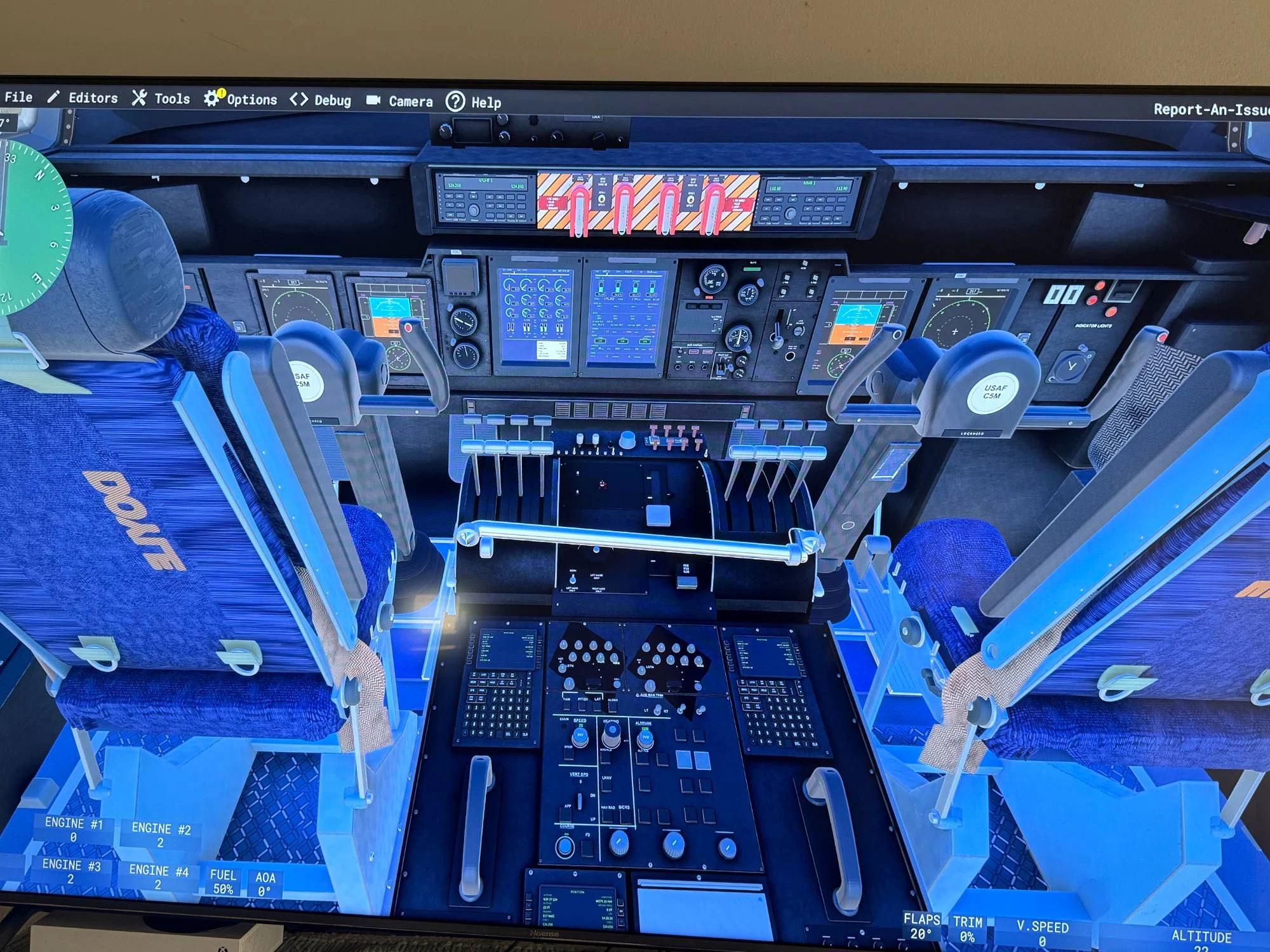
FROM THE PILOT'S SEAT
The flight-deck program addressed angled instrument pods, the accepted three-CDU pedestal, throttle quadrant, yokes, seats, overhead, engineer and navigator stations, windows, floor, and ceiling. Reference photographs guided the form and finish.
Historical simulator captures document the evolving aircraft. They are not presented as screenshots of the latest installation.
VISUAL RECORD
Open an image to see the complete frame. Simulator captures, diagnostic renders, and real-aircraft references are labelled separately.
THE PRODUCTION METHOD
The process improved when every decision could be traced to a reference, a specific artifact, and the thing observed in the simulator.
Owner photographs defined the modern AMP layout and retained C-5 hardware. Matterport plates, official images and diagrams added spatial and mechanical context.
Blender profiles, curves and modifier stacks handled exact hardware. Painter and texture-channel analysis handled finish. World-space measurements kept scale and placement explicit.
Pack and transfer scenes with hashes. Use the Spark queues, identical cameras and close-up views. Judge the image, then use pixel attribution and controls to locate the cause.
Break the thing a check names before trusting it. Preserve failure evidence. Separate authoring from independent review, and distinguish source, compiled, installed and native results.
Use the public aircraft entrypoint for SDK compilation and authorised test installation. Compare deployed files and retain the previous complete package.
Watch displays paint, change and restore events, capture visible motion and lighting, and obtain owner judgement. Feed remaining defects into the next bounded round.
DOCUMENTED RESULTS
Main panel and coaming, the three-CDU pedestal, quadrant, overhead, seats, yokes, engineer and navigator areas, windows, floor and ceiling all received dedicated authoring and review work. Historical native images document the evolving implementation; several surfaces still need final visual acceptance.
The 0.5.46 native report documents attitude, navigation, engine, systems and CDU values on the main displays. It also records residual gear and engine-data errors and unavailable sources. Eighteen authored gauge surfaces describe project scope, not a claim of eighteen fully validated systems.
The 0.5.46 report records 168 Input Events swept: 167 answered, 146 changed and restored, and 21 momentary buttons returned. Gear was skipped on the ground. Event response did not prove every downstream effect or every owner mouse click.
The latest 0.5.74 build receipt records SDK exit zero. The installation record reports 3,635 verified files and retains the complete previous package. The October 1 manifest read matches 0.5.74; no full installed-file audit was rerun for this case study.
The documented Spark fleet used two GB10 hosts with 121 GB unified memory each. Packed scenes, transfer hashes, locking queues and memory guards supported resumable render and analysis work. Windows remained the build and simulator host.
Correct glTF partition decoding eliminated fabricated diagnostic geometry. Pixel attribution, material controls and full assembly views exposed the difference between a surface mark and a physical join problem. These methods narrowed the work that still remains.
Results are drawn from archived project reports and receipts. Historical aircraft checks were not rerun for this portfolio. Complete aircraft acceptance remains open.
A CONTROL THAT CHANGED THE APPROACH
The selected 0.5.74 repaint reduced old paint traces. The upper outline and lower physical slash survived. Failed bridge and broad-shell geometry candidates were excluded from installation.
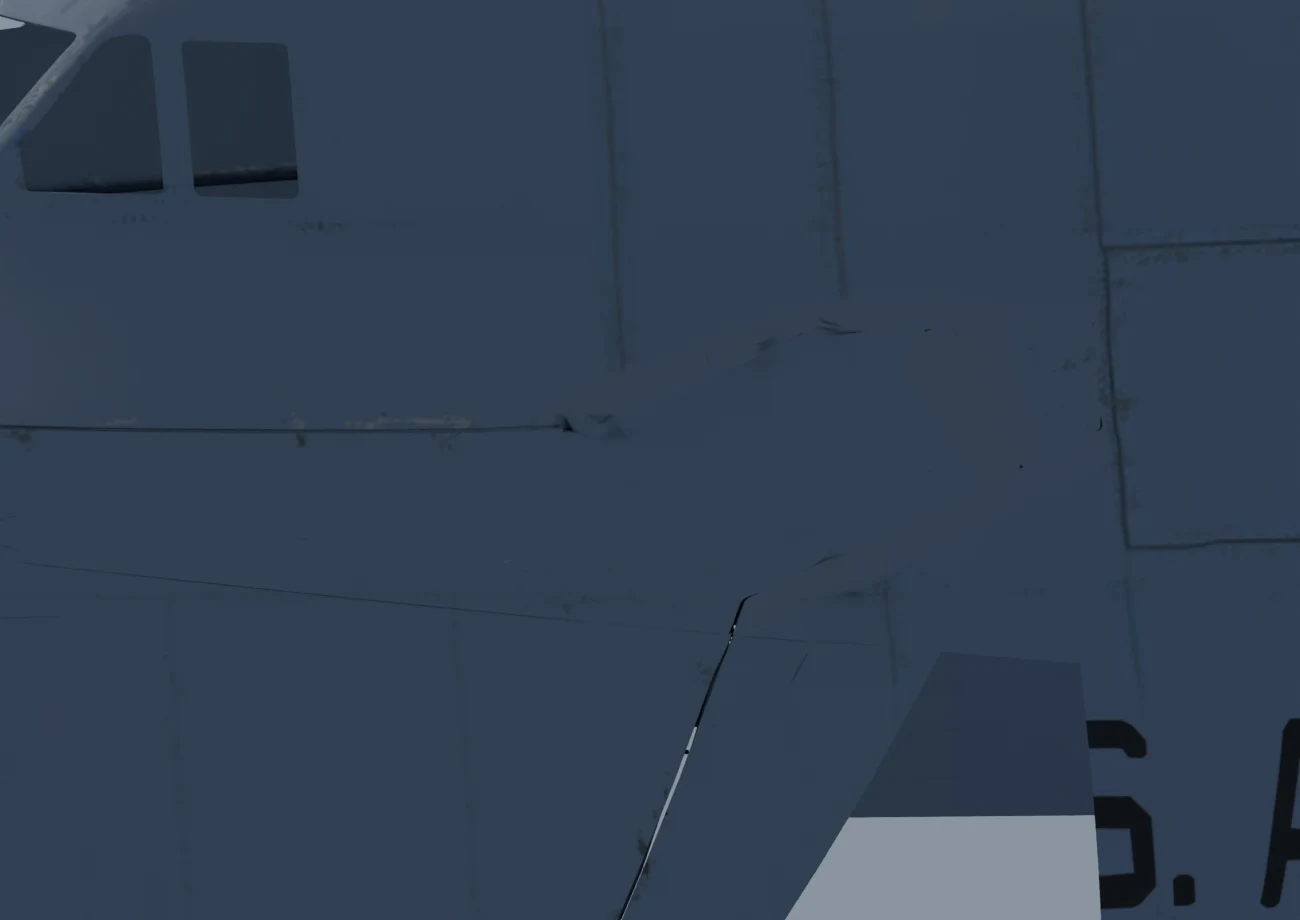
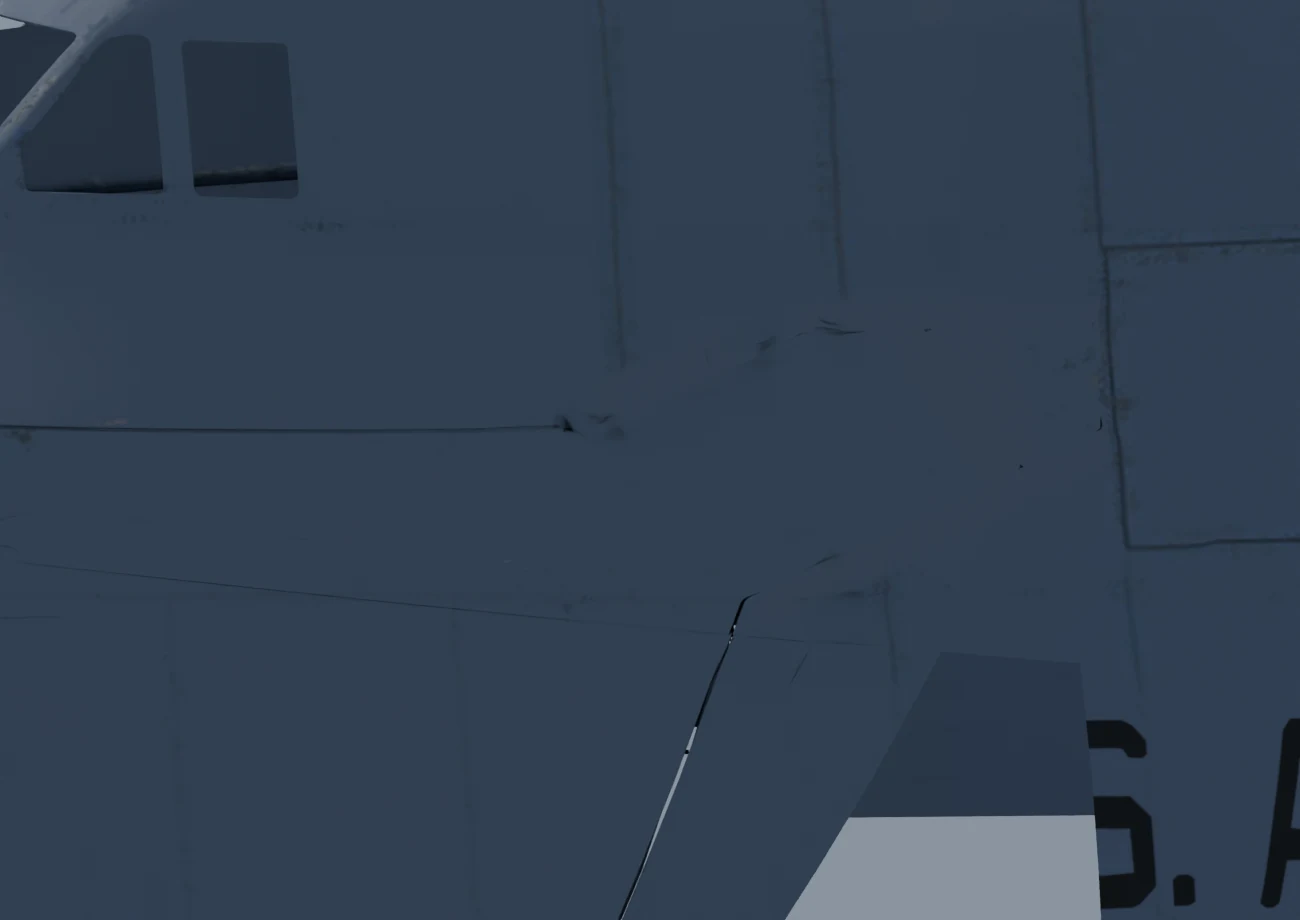 0.5.73 SOURCE0.5.74 PAINT
WHAT WORKED
Photo-aligned cameras and world-space vertex measurements made geometry decisions more concrete. When owner feedback exposed wrong shape, the work shifted from finish adjustments to measured construction.
A recorder once discarded valid replies because it expected the wrong aircraft object ID. A decoder fabricated 499,312 exterior triangles. Broken-input controls and native observations became required evidence.
A clean isolated receiver did not accept the complete rudder assembly. A rendered light did not establish native illumination. A verified install did not establish an accepted aircraft.
THE CURRENT SNAPSHOT
Latest documented package: 0.5.74. Manifest identity rechecked October 1, 2026.
The latest delivery is a partial bilateral Painter repaint. Visible nose contours remain. The follow-up native attempt did not obtain a loaded-aircraft appearance or motion observation.
Full nose and rudder quality, current-build native checks, EFB flicker and clicks, night and camera coverage, automatic callouts, and performance diagnosis remain open. Release selection stays STOP; final owner acceptance has not been recorded.
This project demonstrates substantial production and engineering work. The evidence does not support a completed, study-level, or performance-optimised aircraft claim.
Read the detailed project accountPROJECT DOCUMENTATION
The detailed scope, process, evidence, limitations and source credits in a standalone document.
RESEARCH AND ATTRIBUTION
Project records distinguish modern C-5M layout authority from earlier C-5 hardware detail. Reference photographs show the real aircraft and are not presented as work produced by NeuroAI Studios.
Spatial reference for cockpit, stations and cabin. The scan was used as a reference, not an absolute survey.
Jonathon Carnell, 60th Air Mobility Wing, May 5, 2021. Real-aircraft interior and equipment reference.
Roland Balik / U.S. Air Force, April 16, 2014. Public-domain reference photograph displayed in the gallery.
Heide Couch / U.S. Air Force, March 13, 2019. Public-domain wheel reference displayed in the gallery.
Project-held technical reference for door, ramp and equipment relationships. Historical C-5 references require variant judgement.
Export and simulator integration reference.
Reference for profile and modifier-based hard-surface construction.
Credit for historical donor-derived cockpit assets. Repository attribution records original 3D assets under CC BY-NC 4.0.
Noncommercial licence referenced by the project attribution record.
Purchased private-development hardware input recorded in the project kit inventory.
Purchased private-development hardware input recorded in the project kit inventory.
Historical simulation benchmark recorded in the reference pack; not native evidence for this project.
Owner-selected AMP and night photographs supplied additional visual authority in the local project. Their images are not republished here. Historical donor asset modifications include cockpit isolation, airframe refitting, material adaptation, and integration of C-5 controls and displays. The later project rules reject a complete C-17 deck transplant as a candidate. Delta Simulations retains credit for donor-derived assets; the repository records a noncommercial aircraft package.